
Anandra George's Teaching: Approach, Method, and Voice
The Shape of Practice
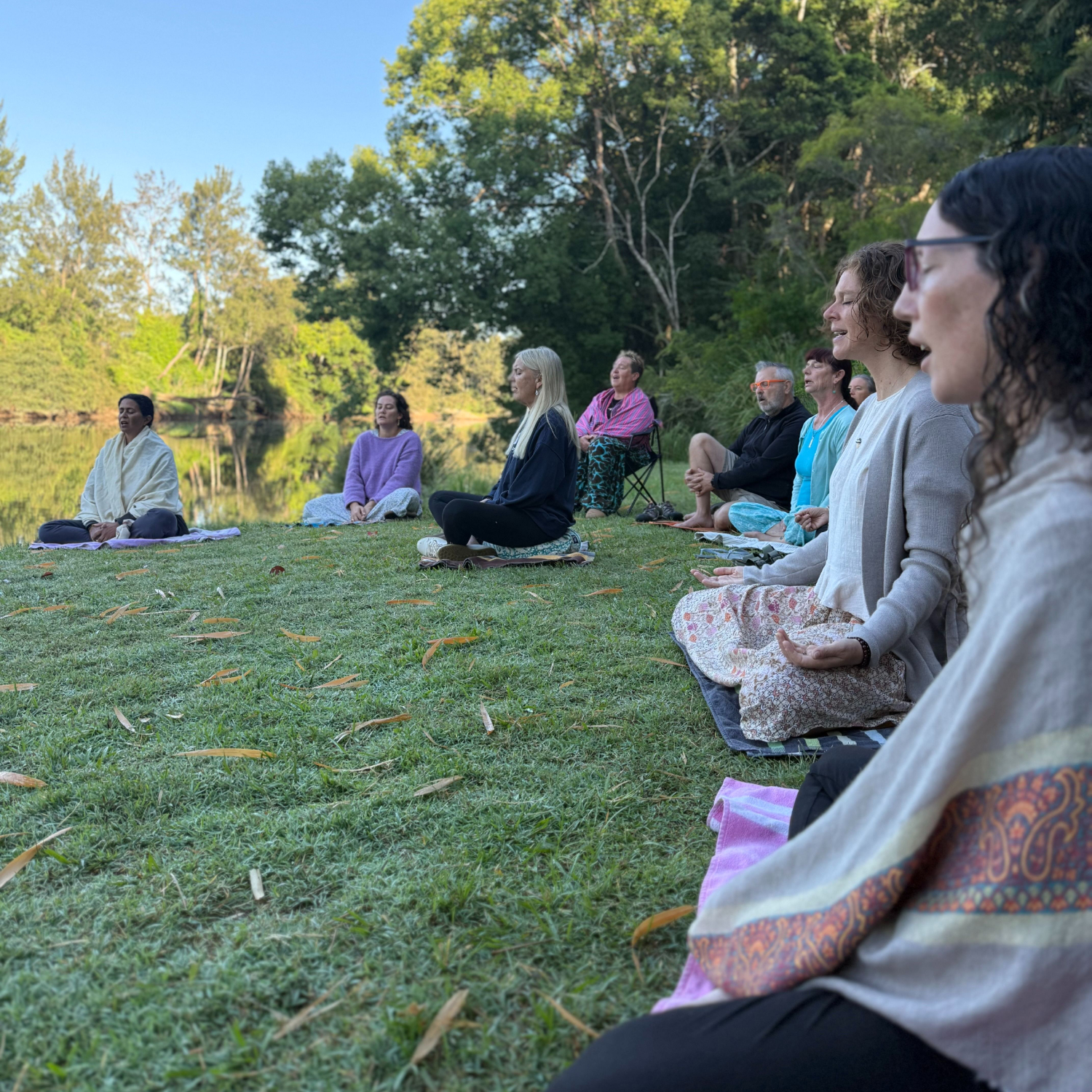
An Anandra George session doesn't announce itself loudly. It begins in the body—seated on cushions or chairs, attention drawn first to breath, then to the subtle preparation of voice as instrument. Whether leading a weekend retreat or a single evening of kirtan, she structures the experience as a gradual descent into devotional space. The opening might include simple toning exercises, grounding the group in their own capacity to produce sound without self-consciousness. Only then does the chanting begin, building from whisper to full voice, harmonium providing the tonal foundation that allows even uncertain singers to find their way in.
Her retreats follow a similar arc over days: mornings for practice, afternoons for teaching or silence, evenings for extended kirtan that can stretch two hours or more. There's no rush to ecstatic states. She treats chanting as labor—patient, repetitive, occasionally tedious in the way that all genuine spiritual practice must be. The emotional peaks arrive, when they do, as byproducts of sustained attention rather than manufactured climaxes.
Recurring Territory
George returns obsessively to several questions: What does it mean to offer one's voice as seva, as service? How does repetition—the same mantra, the same melody, night after night—transform rather than dull awareness? She speaks frequently about the relationship between individual expression and communal harmony, the way a kirtan circle requires both personal surrender and full presence.
The tension between aesthetic excellence and devotional authenticity appears regularly in her teaching. She is herself a trained musician, versed in the structures of Indian classical music, yet she insists that technical perfection is never the point. "We're not performing," she'll say, then immediately complicate it: "but we're not being careless either." This middle way—cultivated skill in service of something beyond the self—defines much of her pedagogical territory.
She also teaches about lineage, the way practices carry the imprint of those who've chanted before. Her own connection to the Bhakti tradition isn't presented as abstract theology but as embodied inheritance. Students hear stories of her childhood immersed in devotional song, of the teachers who shaped her understanding that kirtan is not personal expression but participation in something ancient and larger.
Questions for Sitting
The inquiries George leaves with students aren't koan-like or mysterious. They're direct: Where does your attention go when you're uncomfortable? What happens in your body when you sing the divine's name? Can you stay present when the melody bores you, when your voice cracks, when the person next to you sings off-key?
She pushes practitioners to notice the moment devotion curdles into performance anxiety, or when communal practice triggers the ego's hunger for recognition. These aren't questions to answer intellectually but to inhabit over months of practice.
The Aesthetic of Delivery
George teaches through demonstration more than discourse. She'll offer context for a particular mantra or raga, but briefly—five minutes of explanation, then forty minutes of chanting. Her use of silence is structural rather than dramatic; she simply stops when the chant has run its course, letting the resonance fade naturally.
Humor appears sparingly, usually self-deprecating observations about the peculiarities of spiritual practice. She quotes scripture economically, drawing primarily from Bhakti poetry and occasionally from her own teachers. Stories, when they come, are personal but never confessional—glimpses into her journey offered as teaching illustrations, not therapy.
Her voice itself carries the teaching: trained but not showy, capable of both restraint and power. There's no affectation of exotic pronunciation, no spiritual affect. She sounds like someone doing her job with care.
Who It's For
This teaching lands for students willing to commit to repetition, who can tolerate slowness and find depth in apparent simplicity. It attracts musicians looking for practice beyond performance and spiritual seekers suspicious of charismatic teachers or emotional manipulation. Those shaped by yoga communities, particularly practitioners interested in bhakti's devotional dimension, find familiar ground here.
It bounces off anyone seeking quick transformation, dramatic breakthroughs, or the teacher as guru-authority. Her insistence on practice over theory frustrates the intellectually inclined, while her musical precision can intimidate those who simply want to lose themselves in sound. The teaching requires showing up, repeatedly, without guarantee of revelation—a prospect some find liberating and others find unbearable.
The Wider Lineage
George belongs to the stream of Western teachers bringing Bhakti practices into contemporary contexts without claiming guru status or attempting to recreate ashram culture wholesale. Her work shares territory with kirtan wallahs like Jai Uttal and Krishna Das—musicians who function as facilitators rather than performers, holding space for communal devotion while maintaining artistic rigor. She carries forward a tradition that understands chanting as yoga, as practice, as the slow work of tuning the instrument of self toward something beyond it.