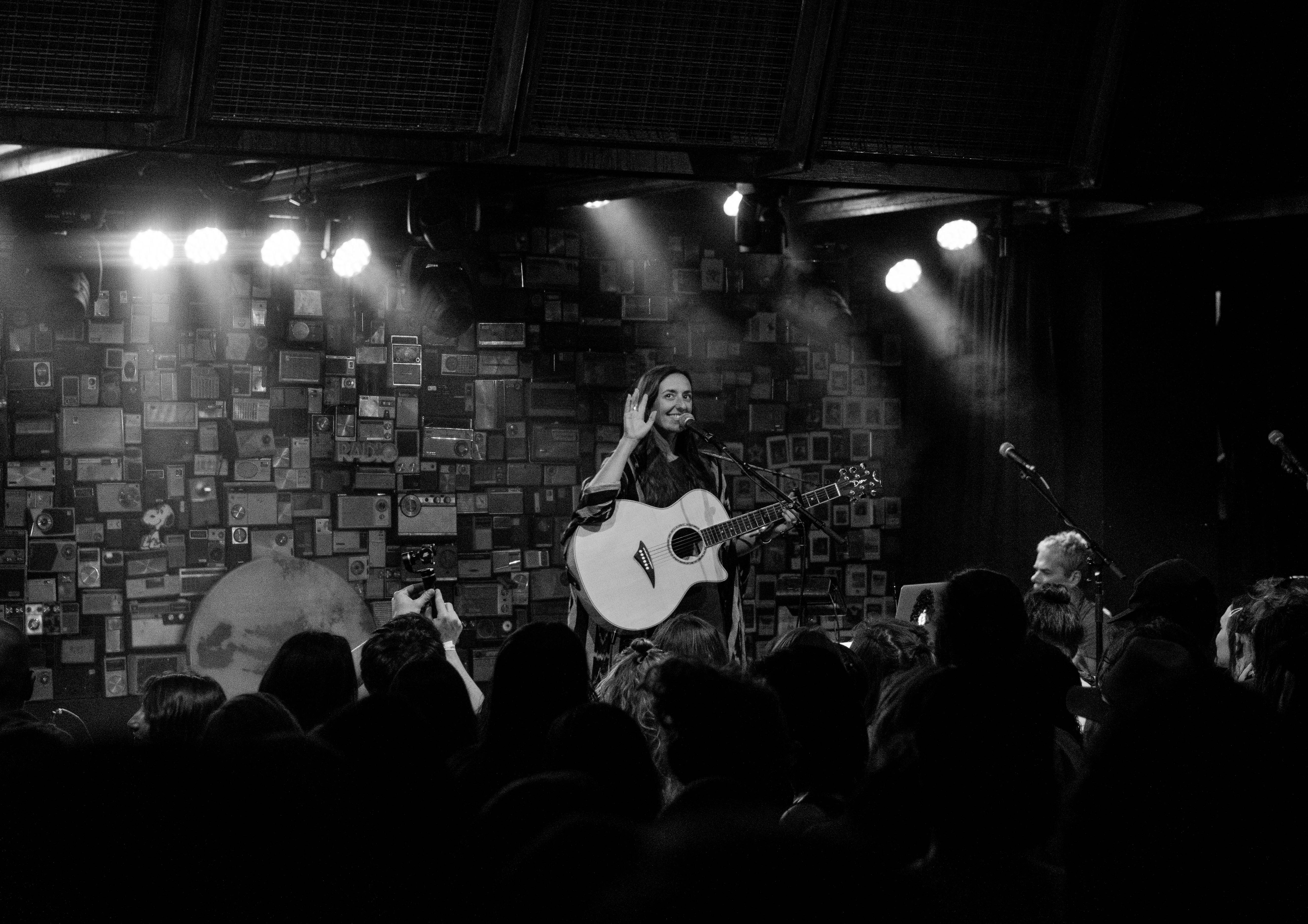

Into The River by Ayla Nereo: A Listening Guide
Released in late 2022, "Into The River" arrives as a singular offering in Ayla Nereo's evolving catalog—not an album but a single track that functions as a complete meditation unto itself. For an artist known for weaving elaborate sonic tapestries across full-length releases with Wildlight and Starling Arrow, this standalone piece represents a distillation rather than expansion: one river, one journey, one unbroken prayer. It's the kind of release that suggests an artist pausing to honor a moment of clarity, a threshold crossed, before moving forward. In Nereo's arc, "Into The River" feels like both an offering and an invitation, a bridge between the forest-folk mysticism of her earlier work and something more elemental, more stripped to bone and breath.
The Sonic Character
"Into The River" inhabits a space where ambient devotion meets earthbound folk, where the electronic and acoustic blur into something that feels neither produced nor raw but simply present. The track unfolds with patience, building its atmosphere through layered vocals that cascade and overlap like water over stone. Nereo's voice—always her primary instrument—moves through the piece in multiple registers, from whispered incantations to soaring harmonies that suggest both solitude and chorus, one woman containing multitudes.
The instrumentation remains subtle, almost deferential to the voice. There's a sense of organic electronics: drones that might be synthesizer or might be bowed strings held until they transcend their source, percussive elements that feel more like heartbeat than rhythm section. The pacing is glacial in the best sense—unhurried, allowing each phrase to settle and resonate before the next arrives. The mood is neither joyful nor sorrowful but somewhere in that liminal space where grief and gratitude become indistinguishable, where surrender feels like the only honest response to beauty.
What Makes It Land
Because "Into The River" exists as a single track, the listening experience is unified and singular. What makes this piece distinctive is its refusal to resolve into easy categorization. It's too spacious to be simply a song, too structured to be pure ambient drift, too intimate to be ceremony yet too ritualistic to be merely personal. The track's power lies in its patience—it doesn't rush toward climax or catharsis but instead creates a sustained space for transformation to occur at the listener's own pace.
The vocal arrangements are where Nereo's craft truly shines. She builds a one-woman choir that suggests the kirtan tradition without directly imitating it, creating call-and-response with her own layered voice. There's a wordless quality to much of the piece, or rather, the words that emerge feel more like tones, vibrations meant to be felt in the body rather than parsed by the mind. This approach connects the work to a broader devotional tradition—bhakti yoga's emphasis on sound as spiritual practice—while maintaining Nereo's distinctive Northern California earth-mysticism, her sense of the divine as immanent in forest, river, stone.
Place in Tradition
"Into The River" sits at an intersection of multiple traditions without belonging fully to any. It shares DNA with the Western kirtan movement—artists like Jai Uttal or Krishna Das who brought Hindu devotional practice to American spiritual seekers—but Nereo's approach is less explicitly tied to Sanskrit mantra or Indian classical forms. Instead, she seems to be reaching for something pan-devotional, a kind of earth-based reverence that could resonate across contemplative traditions.
The track also exists in conversation with ambient and experimental folk artists who use repetition and space as spiritual technology—think Grouper's fog-shrouded meditations or Julianna Barwick's vocal loops. But where those artists often emphasize isolation and interior landscape, Nereo's piece feels more explicitly oriented toward connection, toward the dissolution of self into something larger: the river itself, perhaps, as both metaphor and literal presence.
Who This Is For
"Into The River" lands hardest for listeners who are less interested in songs than in sonic spaces to inhabit. It's for those already familiar with meditation, breath work, or other contemplative practices—people who won't be frustrated by the lack of conventional structure but will recognize it as a container for their own inner movement. This is music for thresholds and transitions: grief work, preparation for ceremony, integration after profound experience, or simply those moments when the soul needs to be held without words.
It will resonate particularly with listeners who've found traditional religious music either too culturally specific or too formal, but who still hunger for music that serves a devotional function. Nereo offers a third way: reverence without dogma, structure without rigidity.
How to Listen
"Into The River" asks for—demands, really—a specific quality of attention. This is headphone music, evening music, ideally experienced alone or in intimate company. Light a candle, if that's your language. Sit or lie down. Let it play through at least twice; the first listen is almost always spent in the thinking mind, cataloging and analyzing. The second is where you might actually enter the river.
Consider it for ritual use: preparation for meditation, accompaniment to gentle yoga or conscious movement, or simply as a sonic threshold between the day's demands and the night's release.